
SUNLU Filament Dryer Box 2026
4.3Editor score
Built-in fan for airflow
LCD visual display
Affordable pricing
This expert guide compares the top filament dryers for 3D printing to help you choose the best dryer for your PLA, PETG, ABS, and nylon spools.
Selecting the right filament dryer for 3D printing is crucial for achieving high-quality prints without defects. Moisture absorption can lead to stringing, bubbling, and poor layer adhesion. A dedicated dryer box ensures your spools remain dry and ready for use.
We have evaluated ten top-rated filament dryers based on capacity, heating efficiency, temperature control, and ease of use. Each product offers unique features designed to meet the needs of hobbyists and professionals alike. Our analysis focuses on performance and reliability.
Each pick highlights key specifications, pros, and cons to help you make an informed decision. While pricing varies, the focus remains on value and functionality. Please note that prices and availability may change over time on the retailer's website.
4.3Editor score

4.6Editor score

4.5Editor score
The following comparison table outlines the key specifications of each filament dryer to help you understand the differences at a glance.



This Creality Space Pi X4 filament dryer stands out as a top choice for serious users. With a rating of 4.6 stars, it is highly rated for its ability to handle multiple spools. The dual heating chambers ensure rapid moisture removal for various materials.
We may earn a commission when you buy through this link, at no additional cost to you.
The standout feature is the dual independent 200W heating chambers that heat up to 85C. This allows for faster drying compared to single-chamber dryers. The spacious design holds four standard 1kg spools, making it ideal for high-volume printing needs.
While it excels in performance, the higher price point may be a consideration for budget users. The large footprint also requires significant desk space. However, the efficiency and capacity justify the investment for professionals.
If you need a reliable solution for drying multiple spools quickly, this model is an excellent choice. Its precise temperature control and sealed storage make it versatile for PLA, PETG, and ABS. We recommend it for users prioritizing performance.
The dual heating chambers remove moisture 30% faster than standard dryers. This ensures your filament is print-ready in hours instead of days.
Beyond drying, the unit maintains humidity during printing pauses. The silicone-sealed enclosure prevents moisture re-absorption to keep spools dry.
We may earn a commission when you buy through this link, at no additional cost to you.
The SUNLU S1 Plus is a budget-friendly option that delivers solid performance for casual users. It has a 4.3-star rating and is known for its simple yet effective drying features. The fan design helps speed up moisture discharge from filaments.
We may earn a commission when you buy through this link, at no additional cost to you.
Its key strength lies in the visual display and personalized settings. The 2-inch LCD screen accurately shows temperature and humidity. You can adjust settings for different filament types to ensure optimal drying conditions for PLA and PETG.
The capacity is limited to smaller spools which might not suit large volume needs. The build is functional but not premium. Despite this, the price point makes it accessible for anyone needing a basic dryer.
For those on a tight budget, this unit provides excellent value. It effectively solves stringing and clogging caused by wet filament. We suggest it for beginners or those with limited storage space.
The upgraded fan design speeds up the discharge of excess water. This reduces the impact of wet weather on 3D filament printing.
Hold the left button to change dry time and press the right for temperature. The interface is intuitive for quick adjustments.
We may earn a commission when you buy through this link, at no additional cost to you.
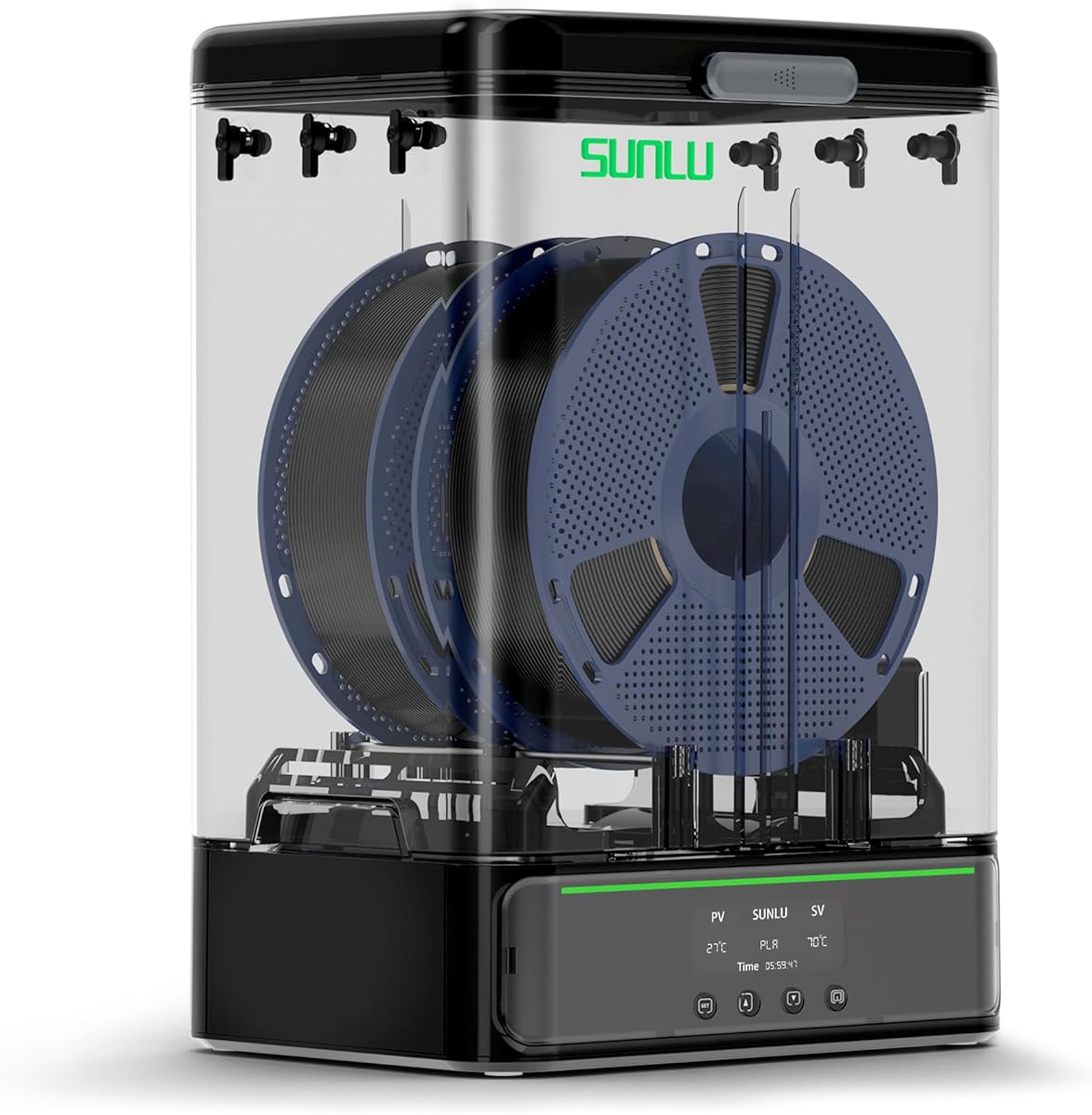
The SUNLU S4 is a premium dryer designed for extensive 3D printing needs. It holds four 1kg spools and is highly rated at 4.5 stars. The powerful 350W PTC heater offers safety and high efficiency for drying.
We may earn a commission when you buy through this link, at no additional cost to you.
Three circulation fans ensure consistent temperature across the entire area. This 360 surround heating prevents hotspots. The eight filament exit holes support multiple printers, making it a versatile workstation hub.
The large size and weight require dedicated space. The dimensions are substantial which might not fit in smaller workstations. However, the capacity and performance are unmatched for multi-printer setups.
If you run multiple printers or large spools, this unit is ideal. The DIY customization options allow you to adapt it for 3kg rolls. We recommend it for professionals needing robust and reliable drying.
With eight exit holes, you can feed multiple printers simultaneously. This enhances efficiency and printing quality during drying sessions.
The 350W PTC heater is 50% higher than previous models. This provides faster heating and better energy efficiency.
We may earn a commission when you buy through this link, at no additional cost to you.
This SUNLU S2 is specifically designed to remove excess moisture and revive old filament. It has a 4.3-star rating and is praised for its effectiveness in saving damp spools. The built-in spindle ensures continuous spinning for even drying.
We may earn a commission when you buy through this link, at no additional cost to you.
The large touch screen makes it easy to customize drying times and temperatures. Users can set specific parameters to suit different needs. The translucent lid allows visual checks without opening the unit.
While it is effective at drying, it lacks a humidity monitor for storage. The capacity is limited to one standard spool which might be restrictive. The build is solid but basic compared to newer models.
If you have old spools that need reviving, this is a great tool. It saves time and money by avoiding replacement. We suggest it for users needing a simple solution to save damp material.
The built-in spindle ensures the filament spins continuously. This promotes even drying across the entire spool surface.
The large touch screen allows you to set dry temps and times with a tap. This ensures quick operation.
We may earn a commission when you buy through this link, at no additional cost to you.
The Comgrow dryer box is known for its large storage volume and simple operation. With a 4.4-star rating, it is a reliable choice for keeping filaments dry. The adjustable temperature range is easy to manage for common materials.
We may earn a commission when you buy through this link, at no additional cost to you.
The 2-inch LCD screen provides clear information display for temperature and humidity. The silicone cable sheath ensures a smooth outlet for filament feeding. The snap button structure on the cover ensures good sealing performance.
The maximum temperature of 50C limits advanced material drying like PC or ASA. Manual setup is required which might confuse some users. However, it is perfect for PLA and PETG users needing a standard solution.
If you prioritize simplicity and storage capacity, this unit is suitable. It avoids entanglement and clogging during printing. We recommend it for casual users working with standard materials.
The inner size allows storage of 2 rolls of 1kg spools. This provides ample space for maintaining dry filament.
The outlet uses a silicone sheath to keep moisture out. The cover snap buttons ensure a tight seal when closed.
We may earn a commission when you buy through this link, at no additional cost to you.
The Creality Space PI Filament Dryer Plus is designed with advanced PTC heating technology. It features a 3.7-inch touch screen for easy operation and monitoring. The built-in fan circulates hot air 360 degrees for uniform heating.
We may earn a commission when you buy through this link, at no additional cost to you.
One key strength is the real-time humidity monitor and 12 filament presets. You can track drying conditions precisely. The one-key settings simplify operation for common materials like PLA and PETG.
The price point is mid-range which may not suit all budgets. The complexity of features might be overwhelming for absolute beginners. However, the monitoring provides better control over drying cycles.
If you want precise control over humidity, this model is excellent. The large touch screen makes it simple to track status. We suggest it for users needing detailed data on their drying process.
Unlike Pl heating pads, the PTC heater ensures uniform drying. It is durable and energy-saving for long-term use.
The presets allow you to select common materials like PLA-CF and ASA. This simplifies temperature settings for different types.
We may earn a commission when you buy through this link, at no additional cost to you.
The SUNLU SP2 is an upgraded dryer designed to hold 2 rolls of 1kg or large 3kg spools. It features a 250W PTC heating element that heats up quickly to 70C. The detachable storage box allows for sealed storage after drying.
We may earn a commission when you buy through this link, at no additional cost to you.
The HD LCD touch screen provides clear readings for temperature and humidity. It supports real-time interior humidity monitoring with a built-in hygrometer. The superior sealing ensures filaments stay dry in storage.
The unit is relatively large and heavier. The price is mid-range which might be a barrier for budget users. However, the support for large spools is a unique selling point for high-volume needs.
If you use 3kg spools, this dryer is ideal. The fast heating and sealed storage protect your investment. We recommend it for users needing large capacity drying and storage.
The SP2 reaches 70C in 15 minutes efficiently. This ensures rapid drying without long wait times.
The base has two gaskets and a latch to ensure a great seal. This keeps filament temp well and dry for use.
We may earn a commission when you buy through this link, at no additional cost to you.
The Polymaker Polydryer offers a connected drying and storage solution. It helps reduce moisture-related issues like stringing and bubbling. The built-in hygrometer helps you judge filament status with less guesswork.
We may earn a commission when you buy through this link, at no additional cost to you.
It promotes even airflow and controlled heating to keep filament prepared. The integrated approach combines heating and desiccant support for ongoing moisture defense. This is ideal for users needing consistent print results.
The drying process relies on a dock which might not heat actively. The design is functional but lacks modern features. However, the storage focus protects spools effectively between sessions.
If you prioritize storage sealing over fast heating, this works well. The hygrometer provides real-time tracking. We suggest it for users needing a complete moisture-control routine.
This unit combines heated drying, sealed storage, and desiccant support. It helps maintain better filament condition over time.
The built-in hygrometer tracks humidity levels inside. This supports better day-to-day management between print sessions.
We may earn a commission when you buy through this link, at no additional cost to you.
The Creality Space PI SE heats up quickly with high PTC efficiency. It is equipped with a precision sensor for accurate temperature control. The thermal insulation cotton keeps the wall warm and anti-scald during printing.
We may earn a commission when you buy through this link, at no additional cost to you.
Real-time humidity monitoring and drying hours are displayed via a countdown timer. This allows you to track drying conditions easily. The knob interface is simple to operate without complex menus.
The single spool capacity might limit high-volume needs. The screen is basic compared to touchscreen models. However, the sensor accuracy ensures safe and effective drying for common filaments.
If you need precise temperature control, this model is suitable. The easy-to-use interface simplifies operation. We recommend it for users needing reliable performance for PLA and PETG.
The precision sensor ensures accurate temperature readings. This allows you to set parameters according to filament type.
Added thermal insulation cotton keeps the inner wall warm. It prevents heat loss and ensures safety during use.
We may earn a commission when you buy through this link, at no additional cost to you.
This SUNLU S4 is similar to the black version but rated highly for its performance. It holds four 1kg spools and features a 350W PTC heater. Three high-quality fans circulate air inside for consistent temperature.
We may earn a commission when you buy through this link, at no additional cost to you.
The 360 surround heating ensures even drying without hotspots. The eight exit holes support multiple printers for versatile loading. Users can adjust parameters to suit specific filament conditions with the timer.
The large size requires dedicated space. The weight is substantial which makes movement difficult. However, the circulation design ensures high-quality drying results for large volumes.
If you need a high-capacity dryer with advanced fans, this is a great choice. The settings are flexible for different materials. We suggest it for users prioritizing consistent drying quality.
Three high-quality fans circulate air inside the unit. This ensures consistent temperature across the entire area for even drying.
The 350W PTC heater offers safety and higher efficiency. It provides better heating performance than previous S2 models.
We may earn a commission when you buy through this link, at no additional cost to you.
When selecting a filament dryer, it is important to consider capacity, heating speed, and temperature range to match your specific needs.
The capacity of a filament dryer determines how many spools it can hold at once. Some units are designed to hold one standard 1kg spool while others can hold multiple or even large 3kg rolls. It is important to measure your workspace and consider how many spools you need to dry simultaneously.
Choose a capacity that fits your printing volume and desk space.
Heating speed varies between models. Some units can heat up to the target temperature in minutes while others take longer. Look for models with PTC heaters which are efficient and safe. Fast heating means less waiting time for your filament to be ready.
Prioritize units with quick heating elements for better workflow efficiency.
Different materials require different drying temperatures. PLA and PETG typically need lower temperatures while materials like ABS or Nylon need higher heat. Ensure the dryer offers a range that covers your materials, ideally between 35C and 85C. A wider range offers more versatility.
Verify the temperature range matches the materials you use regularly.
Some advanced dryers include a built-in hygrometer to monitor humidity levels inside the unit. This helps you track when the filament is dry and ready. While not strictly necessary for all users, it adds peace of mind for precision printing where moisture control is critical.
Consider units with humidity sensors for better monitoring capabilities.
After drying, it is crucial to keep the filament dry until you use it. A good dryer should seal well to prevent moisture re-absorption. Some units double as storage boxes with silicone seals or latches. This integrated approach saves you from transferring filament to separate storage.
Select a unit that combines drying with sealed storage for convenience.
Ease of use is important for daily operation. Look for clear displays such as LCD screens or touch panels that show temperature and time. Simple knobs are also effective for quick adjustments. A user-friendly interface reduces the learning curve.
Choose an interface that is intuitive for your skill level.
Ensure the dryer supports the diameter of your filaments, usually 1.75mm. Most modern dryers are compatible with standard spools. Check if the unit supports various materials like PLA, ABS, and TPU. Compatibility ensures you can use the dryer for all your projects.
Confirm the dryer supports your specific filament diameter and material types.
A durable dryer will last longer and perform consistently. Look for units with insulation to maintain heat and safety. Check reviews for build quality feedback. A well-built unit will provide reliable service over time.
Invest in a dryer with solid build quality for long-term use.
To begin, place your spool inside the dryer box ensuring it spins freely. Close the lid securely to maintain the sealed environment. Connect the power and set the desired temperature based on your filament type.
Monitor the drying time using the timer or countdown display. Once the cycle is complete, keep the spool inside until you are ready to print. If the unit doubles as storage, leave the filament inside between sessions.
Regularly clean the exterior to prevent dust buildup. Check the seals for wear and replace if necessary to maintain effectiveness. Follow the manufacturer's maintenance instructions to ensure longevity.
Yes, if you print with hygroscopic materials like PLA, PETG, or Nylon. Moisture can cause defects such as stringing and bubbling. A dryer ensures your filament remains dry for high-quality prints.
It depends on your environment. If you live in a humid area, drying before every print is recommended. For dry climates, drying every few uses or monthly may suffice.
Yes, many modern dryers are designed to double as storage boxes. Ensure the lid seals tightly to prevent moisture re-absorption during storage.
For PLA, a setting of around 45C to 50C is generally recommended. Avoid exceeding this temperature to prevent damage to the filament.
Drying times vary by model and material. Typically, it takes between 4 to 24 hours depending on the humidity level and the dryer's capacity.
Most modern dryers have safety features like overheat protection. However, always follow the manufacturer's instructions and check for any warnings before leaving it unattended.
PTC heaters are generally considered the best due to their safety and energy efficiency. They provide consistent heating without the risk of overheating.
Some larger models are designed to support 3kg spools. Check the capacity specifications of the unit before purchasing to ensure it fits your needs.
Choosing the right filament dryer can significantly improve your 3D printing results. The Creality Space Pi X4 stands out for its capacity and speed while the SUNLU S1 Plus offers an affordable entry point.
Prioritize factors like temperature range and sealing quality based on your materials. Whether you need a basic solution or a premium unit, there is a dryer to fit your needs.
Always check current prices and availability on the retailer's website before purchasing. A good investment in drying equipment will pay off in print quality and filament savings.