
RIGOL DHO924S
4.5Editor score
250MHz bandwidth with four channels
Built-in signal generator
Bode plot analysis
Digital oscilloscopes are essential tools for engineers, hobbyists, and technicians who need to visualize and analyze electrical signals. They convert voltage signals into graphical waveforms, allowing users to measure frequency, amplitude, and other critical parameters with precision and accuracy.
We evaluated ten leading models based on bandwidth, sampling rates, memory depth, and user interface features. Our analysis considers real-world performance, connectivity options, and value for money to ensure you get a reliable instrument for your specific testing scenarios.
Each product in this list highlights key strengths and ideal use cases for different budgets and applications. Please note that prices and availability can change frequently, so always verify the latest details on the product page before making your final purchase decision.
4.5Editor score
4.3Editor score

4.4Editor score
As an Amazon Associate we earn from qualifying purchases.
The following comparison table outlines the core specifications of each model to help you quickly identify which device meets your technical requirements for bandwidth, channel count, and sampling performance.


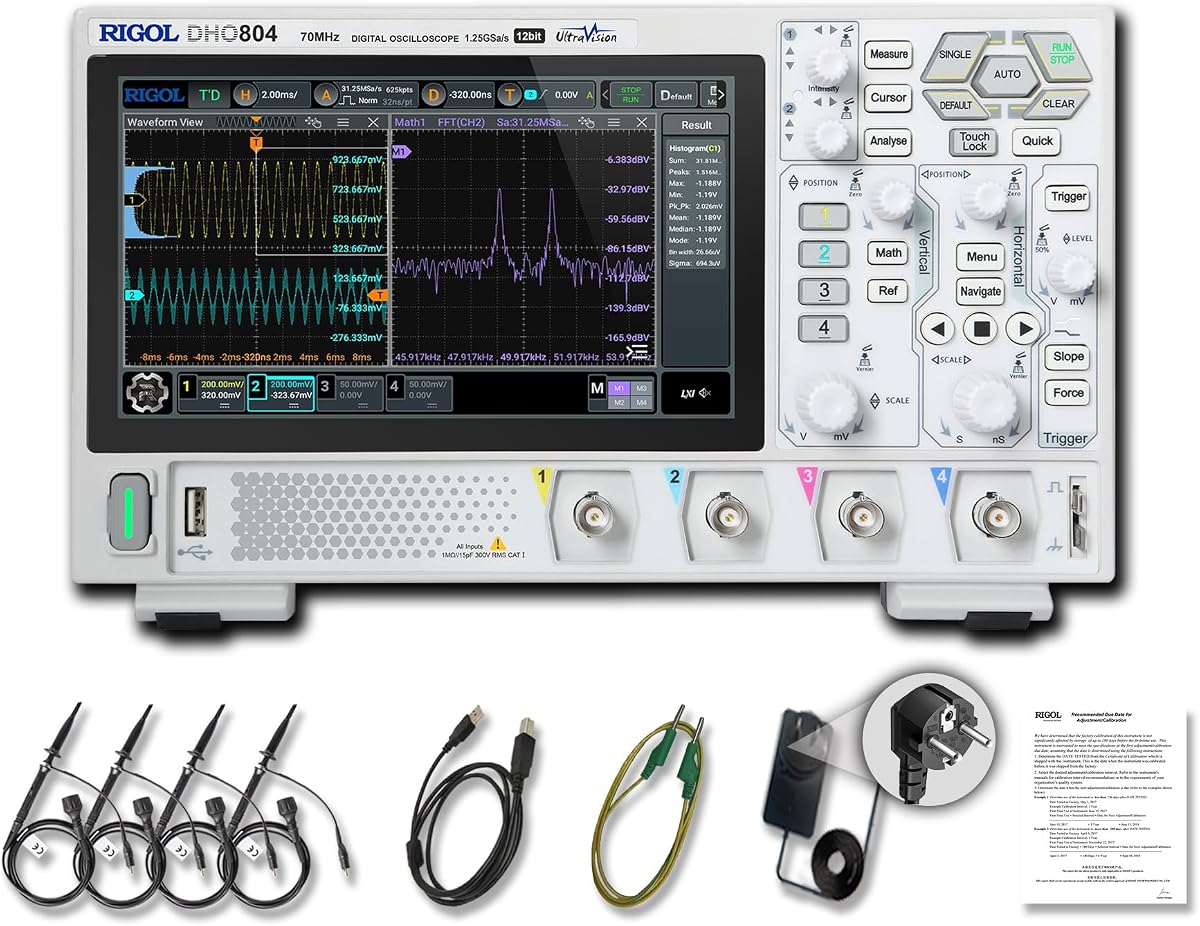
The RIGOL DHO804 stands out as a versatile instrument for modern electronics work. It offers 70MHz bandwidth across four analog channels, making it suitable for complex signal analysis tasks. Its 12-bit resolution provides fine vertical detail that helps visualize noise and ripple effectively.
We may earn a commission when you buy through this link, at no additional cost to you.
UltraAcquire technology allows waveform capture rates up to 1,000,000 wfms/s which is critical for catching intermittent glitches. The 256-level intensity grading displays signal probability over time. Serial trigger support covers CAN, I2C, and SPI for embedded protocol debugging.
While the bandwidth is modest for high-speed digital designs, the resolution and memory depth compensate for many applications. It may not replace high-end spectrum analyzers but is excellent for power supply and sensor interface validation in labs and education.
Engineers needing detailed waveform visibility without excessive cost should consider this model. It balances performance and usability well for general troubleshooting. Check current pricing and availability before purchasing to ensure it fits your specific lab requirements.
The 12-bit resolution provides 4096 vertical levels compared to standard 8-bit. This reveals fine details in power ripple and noise that 8-bit units often miss.
Having four analog channels allows simultaneous monitoring of multiple rails. This helps correlate timing signals across different power domains during embedded system bring-up.
We may earn a commission when you buy through this link, at no additional cost to you.
The RIGOL DHO924S extends the capabilities of the DHO series with 250MHz bandwidth. It maintains the excellent 12-bit resolution and four-channel configuration. The built-in arbitrary function generator simplifies setup for testing and calibration tasks.
We may earn a commission when you buy through this link, at no additional cost to you.
Bode plot analysis is a key feature for loop stability and frequency-response testing. It ranges from 10Hz to 25MHz using the S model output. This reduces the need for external network analyzers in many power supply and filter debugging scenarios.
While highly capable, the price reflects its advanced features and higher bandwidth. Users needing high-speed embedded timing or extensive power loop testing will find value here. It is a robust choice for professional labs requiring precision.
Investing in this model ensures longevity and performance for demanding applications. It supports automation through SCPI and web control. Verify the included accessories and probe compatibility before ordering to meet your measurement needs.
The integrated arbitrary function generator outputs signals directly. This eliminates external equipment for injecting test signals into circuits during debugging and validation phases.
Loop response testing is streamlined with built-in Bode plot tools. It measures gain and phase across frequencies to assess stability without complex external setup.
We may earn a commission when you buy through this link, at no additional cost to you.
The FNIRSI DPOS350P is designed for portability and field use with wide bandwidth. It features a 350MHz bandwidth across two channels and supports X-Y mode for phasor analysis. The touchscreen interface allows quick adjustments during measurements.
We may earn a commission when you buy through this link, at no additional cost to you.
Its integrated spectrum analyzer provides FFT-based analysis from 200KHz to 350MHz. Waterfall views and harmonic markers help identify EMI issues and signal integrity problems. The frequency response analyzer supports Bode plots and filter tuning tasks.
While powerful, the device relies on a built-in battery which limits continuous runtime. The interface may require time to master compared to bench models. However, it offers exceptional versatility for on-site troubleshooting and mobile diagnostics.
Technicians needing a handheld unit with high bandwidth will appreciate its flexibility. It includes a DDS signal generator for testing. Check battery performance expectations before field deployment to ensure it meets your operational hours.
Built-in FFT analysis reveals frequency domain data. Waterfall views help track intermittent interference over time without external equipment.
Battery power enables operation away from mains. This makes it ideal for site visits and maintenance where bench power is unavailable.
We may earn a commission when you buy through this link, at no additional cost to you.
The RIGOL DS1102Z-E is a classic choice for students and hobbyists. It offers 100MHz bandwidth and a very high user rating. Its waveform capture rate reaches 30,000 wfms/s to help find glitches in digital circuits.
We may earn a commission when you buy through this link, at no additional cost to you.
Deep memory up to 24 Mpts allows capturing long records at high sample rates. This helps keep fine details visible even over large timeframes. Serial bus trigger and decode support RS232, I2C, and SPI protocols for embedded work.
While it lacks the channel count of advanced models, it is perfect for basic and intermediate testing. The interface is straightforward for daily use. It balances cost and performance exceptionally well for entry-level labs.
Beginners looking for reliable performance should consider this unit. It supports remote access via LAN and USB. Verify available accessories like probes before purchasing to start testing immediately.
High user ratings reflect reliability. It consistently delivers stable measurements for education and repair tasks.
Deep memory supports detailed historical data. You can review long events without losing high sample rate resolution.
We may earn a commission when you buy through this link, at no additional cost to you.
The FNIRSI 2C53T combines a 50MHz oscilloscope with a multimeter and signal generator. It handles voltage and current measurements alongside waveform analysis. This reduces the gear needed for simple maintenance and repair tasks.
We may earn a commission when you buy through this link, at no additional cost to you.
The multimeter supports AC and DC measurements up to 750V and 9.999A. The generator produces standard waveforms up to 50kHz. Touchscreen controls simplify navigation between different tool modes.
This is a solid option for basic electrical work where bandwidth is not critical. It fits easily into toolkits and backpacks. While it lacks high-speed analysis, it is versatile for general troubleshooting.
Hobbyists needing multiple tools in one device will appreciate this design. It saves space and cost. Confirm supported inputs match your common measurement needs before purchasing.
The built-in multimeter handles basic electrical checks. This streamlines testing without switching between separate devices.
Three tools in one unit saves budget. It is excellent for field repairs where carrying multiple meters is impractical.
We may earn a commission when you buy through this link, at no additional cost to you.
The FNIRSI DSO152 is an affordable option for basic waveform viewing. It has 200kHz bandwidth and supports 2.5 MS/s sampling. It fits easily in a pocket and is great for simple electronics diagnostics.
We may earn a commission when you buy through this link, at no additional cost to you.
Its battery life allows hours of continuous use. The display provides clear visibility of standard signals. It offers full trigger modes for capturing periodic and aperiodic events reliably.
It is not suitable for high-frequency audio or RF work. However, for hobbyists learning signal analysis it is a great entry. The price makes it accessible for schools and makers.
Beginners needing a simple, portable unit should look at this. It offers good value for its price. Ensure your required signals fall within the supported bandwidth before ordering.
Its small size allows it to fit in pockets. This makes it ideal for quick checks in the field or workshop.
Low cost reduces entry barriers. It allows students to start visualizing signals without expensive gear.
We may earn a commission when you buy through this link, at no additional cost to you.
The Hantek DSO2D15 offers 150MHz bandwidth with a solid feature set. It supports arbitrary waveform outputs and multiple serial protocol triggers. It is suitable for embedded debugging and general lab work.
We may earn a commission when you buy through this link, at no additional cost to you.
With 14 trigger modes it handles complex signal capture. The package weight is significant as it is a bench unit. It includes tools for aerospace and embedded systems validation.
It is a reliable choice for labs needing more bandwidth than entry-level units. It lacks portable options but offers standard connectivity. For education and commissioning it provides good value.
Technicians needing standard bench analysis should consider this unit. It covers common triggers and decoding needs. Verify included probe specs to ensure safe input voltage handling.
Fourteen modes allow complex event capture. You can target specific edges or patterns reliably in data.
Serial decode covers common standards. It simplifies debugging communication lines in embedded systems.
We may earn a commission when you buy through this link, at no additional cost to you.
The FNIRSI 1013D Plus features a 7-inch touch display for easy navigation. It offers 100MHz bandwidth and two channels. Its battery power supports portable operation away from bench setups.
We may earn a commission when you buy through this link, at no additional cost to you.
It stores waveform images and data for later review. Touch gestures make adjusting cursors and zooming fast. It includes Lissajous graphics for phase comparison tasks.
It balances touch convenience with standard oscilloscope tools. It is suitable for field work and general electronics. While it lacks advanced decoding, it covers most visual analysis needs.
Users preferring touch controls should consider this unit. It provides solid visualization features. Check storage capacity and backup options for your workflow.
The touchscreen allows gesture navigation. You can zoom and adjust cursors directly with your finger.
Built-in storage saves screenshots and data. This helps document and review test results later.
We may earn a commission when you buy through this link, at no additional cost to you.
This listing represents an alternative option in the market. Specific details are not provided in the source data. It may offer a different form factor or unique features.
We may earn a commission when you buy through this link, at no additional cost to you.
It is important to verify specifications before purchase. Ensure it meets your bandwidth and channel needs. It may serve as a backup or specialized unit.
Without full data we cannot evaluate performance. Check user feedback or product manuals. It might be a new or niche product.
Consider comparing with fully documented models. Ensure it offers value and support. Verify compatibility with your test setups.
Verify specs before purchase. Ensure it matches your technical requirements.
It may offer a unique form factor. Check if it suits your niche needs.
We may earn a commission when you buy through this link, at no additional cost to you.
This listing represents another market option. Details are not provided in the source data. It may offer a competitive price or features.
We may earn a commission when you buy through this link, at no additional cost to you.
It is important to check specifications before purchase. Ensure it meets your bandwidth and channel needs. It might suit a specific budget.
Without full data we cannot evaluate performance. Check user feedback or manuals. It might be a niche or older product.
Consider comparing with documented models. Ensure it offers value and support. Verify compatibility with your test setups.
Verify specs before purchase. Ensure it matches your technical requirements.
Market variety offers many options. Check if it suits your needs.
We may earn a commission when you buy through this link, at no additional cost to you.
Choosing the right oscilloscope involves balancing bandwidth, channels, memory, and budget.
Bandwidth determines the highest frequency the scope can measure accurately. Aim for at least five times your signal frequency to capture harmonics. This prevents aliasing and ensures accurate rise time measurements.
Higher bandwidth increases cost significantly. Match it to your actual needs.
Two channels suffice for simple circuits. Four channels help analyze multi-rail power supplies. More channels allow simultaneous probing of inputs and outputs.
Consider future needs before buying a limited scope.
Sampling rate must exceed bandwidth by at least four times. Higher rates capture fast transients better. This ensures waveform reconstruction fidelity.
Look for real-time rates over 1 GSa/s for digital signals.
Memory depth allows capturing long events at high sample rates. Large memory helps see rare glitches without resampling. This improves debugging for intermittent issues.
Prioritize memory if analyzing long serial streams.
Vertical resolution impacts noise and ripple visibility. 12-bit models show finer details than 8-bit. This helps analyze power quality and low-level signals.
High resolution is key for power integrity tests.
USB, LAN, and HDMI help transfer data. Automation support via SCPI aids remote testing. These features save time in documentation.
Ensure ports match your workflow requirements.
Touchscreens allow faster navigation. High resolution helps see details in dense waveforms. Larger displays reduce eye strain.
Consider ergonomics if using daily for long periods.
Battery-powered handheld units aid field work. Bench scopes offer more processing power. Match the form factor to your work environment.
Weigh weight and battery life carefully.
Connect probes to the channel inputs and set the probe attenuation to match the physical switches. Ground the probe clip to a common ground to avoid noise and floating potentials.
Use auto-set to initialize waveform scaling. Adjust timebase and voltage scale to focus on features of interest. Use cursors for precise voltage and time measurements.
Store waveforms using internal storage or export to PC via USB or LAN. Regularly update firmware for new features. Store the unit in a dry, cool place.
Bandwidth defines the highest frequency the analog front end can pass. Sampling rate is how often the ADC samples the signal. High bandwidth needs high sampling to prevent aliasing.
Two channels work for simple circuits. Four channels help monitor power rails and ground simultaneously. This correlates timing across signals effectively.
FFT converts the time-domain signal to frequency domain. It identifies noise sources and harmonics. This helps EMI debugging and signal analysis.
Memory depth captures long events at high sample rates. It helps analyze long serial packets. It prevents losing details due to memory wrapping.
Passive probes are standard for general use. Active probes reduce loading on high impedance circuits. Differential probes measure across floating points safely.
Yes, many scopes measure frequency and period. This is useful for quick checks. Dedicated counters may offer higher precision.
We reviewed ten models ranging from portable budget units to advanced bench instruments. Each offers distinct strengths for different testing and validation scenarios.
Prioritize bandwidth and channel count to match your projects. Consider memory and resolution for power and signal integrity work.
Prices and availability change regularly. Verify the latest details before purchasing.