
SHILLEHTEK Universal Power Supply Module
4.6Editor score
Universal MB102 Compatibility
Dual 3.3V and 5V Output
Flexible Input Options
This guide compares the top 12V breadboard power supply options for makers, helping you choose reliable power for Arduino and electronics projects today.
Finding the right power source is essential for any electronics project. A good 12V breadboard power supply ensures stable voltage and current for your components. Without it, your circuit may fail or get damaged during prototyping sessions.
We evaluated ten top-rated modules based on input options, voltage stability, and ease of use. Our list covers budget picks and advanced kits suitable for students and professionals. Each option supports standard breadboards and common microcontrollers.
Each product entry details key specs, pros, and cons to help you decide quickly. These supplies range from simple regulators to variable adapters with extra features. Prices may change, so check current listings before ordering your next project kit.
4.6Editor score

4.5Editor score

4.8Editor score
This side-by-side comparison highlights the unique strengths of each module to help you match the right power source to your specific needs and project scale.




This dual-channel module stands out for its versatility and safety features. It offers a 4.5 star rating and supports both Type-C and traditional DC inputs. This flexibility makes it ideal for modern and legacy setups.
We may earn a commission when you buy through this link, at no additional cost to you.
Each side has independent voltage selection and switches. You can run 3.3V on one side and 5V on the other simultaneously. The concave design saves breadboard space and ensures a flush fit.
The onboard protection limits current to protect microcontrollers. However, this module requires a separate adapter for DC input which adds to the cost. Still, the safety and convenience outweigh this minor drawback for most users.
This is the top pick for makers needing reliable power distribution. It suits Arduino and Raspberry Pi projects perfectly. Buy this if you want flexibility and protection in your workbench setup.
You can use modern Type-C chargers or classic DC adapters to power your breadboard easily.
Turn off one side or set different voltages without affecting the other channel for complex circuits.
We may earn a commission when you buy through this link, at no additional cost to you.
This kit offers five modules ideal for classroom or shared workspaces. It holds a 4.2 star rating and covers standard breadboard sizes efficiently. It is a cost-effective solution for many users.
We may earn a commission when you buy through this link, at no additional cost to you.
The package includes 9V connectors for battery power. This adds convenience for portable projects without extra purchases. The modules support common 3.3V and 5V outputs for most hobbyist needs.
Current output is limited to under 700mA. This is fine for logic circuits but not for motors. However, the low cost and quantity make it a smart choice for small component projects.
Choose this if you need multiple supplies at low cost. It is perfect for teaching kits or prototyping groups. Just check current needs match the 700mA limit.
Get five modules for a low price, perfect for stocking up or sharing among students and friends.
The included 9V battery clips let you quickly switch to portable power without buying extra accessories.
We may earn a commission when you buy through this link, at no additional cost to you.
This kit provides everything needed to start prototyping immediately. It includes a board, power module, and adapter. With a 4.0 rating it is reliable for entry-level electronics tasks.
We may earn a commission when you buy through this link, at no additional cost to you.
The included 12V adapter ensures stable input voltage. Jumpers and board are compatible with common microcontrollers. This reduces setup time and extra purchases significantly.
The breadboard is basic but functional for learning. Some may prefer premium boards but the value is high. The power module offers standard 3.3V and 5V outputs.
This kit is best for beginners starting from scratch. It saves the hassle of sourcing parts separately. Buy it if you want an all-in-one solution.
This kit includes all components needed to begin prototyping without needing extra purchases.
The included 12V adapter ensures consistent input voltage for reliable module operation.
We may earn a commission when you buy through this link, at no additional cost to you.
HiLetgo is known for reliable budget electronics parts. This pack offers five modules rated 4.3 stars. It fits MB102 boards and delivers stable 3.3V and 5V outputs.
We may earn a commission when you buy through this link, at no additional cost to you.
The USB input option adds portability for on-the-go work. It is easy to plug into a laptop or bank. The low current limit suits most logic circuits and sensors.
The input range stops at 9V which may limit some DC adapters. However, most 12V adapters work fine within this range. The quality is consistent with the brand reputation.
Select this for cost-effective mass prototyping. It is suitable for labs or shared workspaces. Check input requirements before buying.
Designed to fit perfectly into standard MB102 solderless breadboards for easy integration.
Use USB power for portable projects without needing a separate AC adapter.
We may earn a commission when you buy through this link, at no additional cost to you.
SHILLEHTEK offers a high-rated single module at great value. Its 4.6 rating indicates strong user satisfaction. The wide input range and MB102 fit make it versatile.
We may earn a commission when you buy through this link, at no additional cost to you.
It works with most microcontrollers including ESP32 and Pi. The USB option ensures flexibility for testing. Quality is solid for the price point.
This is a single unit so bulk buyers may want more packs. However, it is perfect for quick replacements or new builds. The efficiency is high for low power tasks.
Pick this if you want top value for a single module. It is best for hobbyists on a budget. Check compatibility with your specific breadboard.
Works seamlessly with any standard MB102 prototype breadboard for broad usability.
Choose between DC adapter or USB power depending on your project needs.
We may earn a commission when you buy through this link, at no additional cost to you.
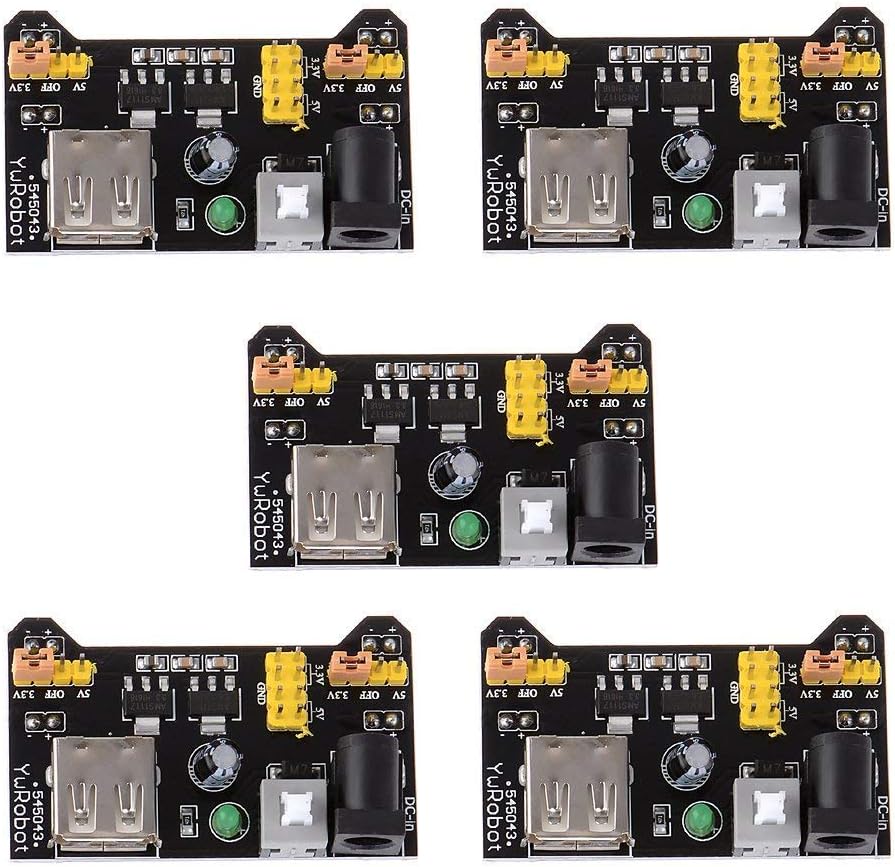
This pack offers five reliable modules with 4.5 stars. It includes connectors for 9V battery power as well. Good for groups or stocking up for future projects.
We may earn a commission when you buy through this link, at no additional cost to you.
The design is simple and effective for most needs. It plugs directly into breadboard rails. The status LEDs help verify active power easily.
The 700mA limit may not suffice for large motors. But for sensors and logic boards it is fine. The included connectors add real practical value.
Choose this for team projects or classrooms needing multiple supplies. It is easy to use and setup. Verify your power needs match the limit.
Comes with five 9V battery quick-connect cables for easy portable testing.
Compatible with both 400 and 830 point solderless breadboards for flexible usage.
We may earn a commission when you buy through this link, at no additional cost to you.
This kit is ideal for advanced users wanting to learn soldering. It offers fixed outputs and an adjustable 12V option. The digital display helps monitor voltage precisely.
We may earn a commission when you buy through this link, at no additional cost to you.
It uses an LM2596 module which is efficient. The fixed outputs cover common needs easily. The adjustable portion allows fine-tuning for unique circuits.
Soldering is required which adds time. Not suitable for those wanting plug-and-play. However the control it provides is worth it for experienced makers.
Select this if you enjoy building and customizing. It is great for labs and workshops. Check your soldering skills before buying.
Fine-tune voltage levels and confirm with the digital display before connecting circuits.
Get 3.3V, 5V, and 12V on a single board to reduce wiring clutter.
We may earn a commission when you buy through this link, at no additional cost to you.
SunFounder offers strong current capacity for demanding circuits. The 1.5A 5V output is higher than standard. It fits many microcontrollers and Pi devices well.
We may earn a commission when you buy through this link, at no additional cost to you.
The extra USB port adds convenience for sensors. The compact size saves space on the board. Build quality is solid with reliable protection.
It does not offer a fixed 12V option like some. This may limit some projects but covers most needs. The extra ampere current is a clear advantage.
Buy this for projects needing more power than typical modules. It is ideal for robotics and IoT. Ensure input adapter is sufficient for current.
Supports up to 1.5A at 5V for driving motors or multiple peripherals safely.
Includes a USB port for powering external modules or sensors conveniently.
We may earn a commission when you buy through this link, at no additional cost to you.
This module has the highest rating and offers great flexibility. It supports input from 5V to 40V which is wide. Multiple output channels help complex builds easily.
We may earn a commission when you buy through this link, at no additional cost to you.
You get fixed outputs plus an adjustable one for custom needs. The LM2596 chipset is efficient and robust. It handles various circuits better than basic modules.
Wiring may be more complex than plug-and-play options. You need to manage input and outputs manually. But the versatility is unmatched for advanced makers.
Pick this for high-end projects or labs needing varied power. It supports professional and serious hobbyists. Verify adapter and wiring needs.
Accepts input from 5V to 40V allowing use with many different power sources.
Combine fixed voltages with adjustable channels to suit complex project needs.
We may earn a commission when you buy through this link, at no additional cost to you.
This is a lab-style adapter rather than a module. It offers adjustable voltage and high current capacity. The LCD shows output voltage in real time for precision.
We may earn a commission when you buy through this link, at no additional cost to you.
It includes many tips and an alligator clip for wiring. The clip connects to breadboards directly without a module. This makes it versatile for testing circuits.
It is bulkier than board modules. However the adjustable voltage covers more scenarios. It is great for prototyping with varied voltage requirements.
Select this for benchtop testing needing variable power. It suits repair and advanced prototyping. Check connector compatibility for your devices.
Adjust output between 3V and 24V to meet different project needs without multiple adapters.
Get multiple DC tips and an alligator clip to power various devices and breadboards.
We may earn a commission when you buy through this link, at no additional cost to you.
Selecting the right power supply depends on your project needs and experience level. This guide covers the essential factors to consider before buying.
Most modules accept 6.5-12V or USB power. Check that your adapter matches the input range to avoid damage. Some support wider ranges like 5-40V for more flexibility.
Always verify input limits to ensure your adapter is safe for the module.
Standard modules offer 3.3V and 5V. Some include 12V outputs or adjustable voltage for custom needs. Match the outputs to your components like Arduino or Raspberry Pi.
Choose modules with multiple outputs to power mixed circuits without extra regulators.
Current limits vary from under 700mA to 3A. Higher current is needed for motors or sensors. Basic logic circuits work fine with lower limits.
Ensure the module can supply enough current for all connected parts.
Look for short-circuit and over-current protection. This protects expensive components from damage. Good modules include LED indicators for status monitoring.
Safety features prevent damage and make prototyping safer and easier.
Most modules fit MB102 or similar breadboards. Check dimensions and pin spacing to ensure a flush fit. Compact modules save space on crowded boards.
Choose sizes that fit your breadboard type and layout needs.
Plug-and-play modules are fastest to set up. Some require soldering for custom builds. Consider your comfort with soldering and wiring.
Pre-assembled modules save time for quick prototyping tasks.
Accessories like 9V clips or tips help flexibility. Some kits include jumpers or adapters. Check what is included to avoid extra purchases.
Included accessories add value and reduce total project cost.
Single units are cheaper upfront but bulk packs offer better value. Classrooms may prefer multi-packs. Weigh cost against features needed.
Buy in bulk if multiple supplies are needed for shared workspaces.
First plug the module into the power rails of your breadboard. Make sure it is oriented correctly with positive and negative pins aligned. Securely insert it until it sits flush.
Connect your power adapter or USB source to the input port. Set the voltage selector switch if available to match your components. Check the LED indicator to confirm power is active.
To protect your circuit, avoid shorting output pins. Keep wires tidy to prevent accidental contact. Store modules in a dry place when not in use.
Most accept 6.5-12V DC or USB power. Some premium models support wider ranges. Always check the module's specs to match your adapter voltage. Mismatched inputs may damage the module.
Yes, many accept 12V adapters. Ensure it falls within the module's input range. Some have limits up to 9V so verify before use. Using correct adapters ensures stable operation.
Most fit MB102 and similar solderless boards. Some fit 400 or 830 point types. Check compatibility before buying to avoid fit issues. Correct fit ensures secure connections.
Current varies by model from under 700mA to 3A. Higher current is needed for motors or multiple parts. Check specs to match your project demands. Avoid exceeding limits to prevent overheating.
Most plug-and-play modules need no soldering. Some DIY kits require assembly. Choose pre-built units for easiest setup. Check the product details for assembly needs.
Two switches allow independent control of each side. This helps power different voltages on each rail. It adds flexibility for complex circuits. Check the manual for switch functions.
Short-circuit and over-current protection are key. They protect components from damage. LEDs show power status clearly. Look for these features when comparing modules.
Some support USB or include battery connectors. This allows use without wall outlets. USB is common for portable testing. Check input options for your needs.
This guide highlights top options from simple modules to advanced kits. Each serves different needs from basic prototyping to complex builds. The editor pick and value kits suit most hobbyists.
Prioritize compatibility and current capacity first. Look for safety features and ease of use. Choose based on your projects voltage and amperage needs.
Prices may change so check listings before purchase. Verify current details match your requirements for best results. Happy prototyping with your new power supply.